Proving Out Of FTE-Flooded Evaporator Technology On A Grocery Store In Minnesota
Report Provided Courtesy of the State of Minnesota’s Commerce Department – Energy Resources
Lunds & Byerlys has a long history of being proactive in minimizing the costs and climate impacts of their grocery stores. So when they started planning for the development of their new Highland Bridge location in St. Paul, they naturally looked at a range of CO2 refrigeration system options. Besides including an adiabatic gas cooler as part of their base design, they evaluated Kysor Warren Epta’s FTE technology for flooding evaporators before deciding to move ahead with the first U.S. installation of FTE in a cold-climate location.
The FTE technology was an attractive option for a couple of reasons. First of all, FTE was a top option for consideration because of its relative simplicity compared to other technology options, like ejectors and parallel compression. A second consideration that set FTE apart is that it provides significant energy savings year-round while most system-level efficiency options for booster CO2 systems primarily provide savings in hot weather only. This year-round savings is achieved because flooding of evaporators in coolers allows the medium temperature suction pressure to increase throughout the year, thereby reducing compressors’ power use.
The higher suction pressure can be achieved because the flooded liquid throughout all of the inside of evaporator cooling coils is able to absorb the same amount of heat with a lower temperature difference between it and the case air blown over it when compared to the typical roughly 50% liquid and 50% vapor on the inside surface of evaporator coils. Lunds & Byerlys included the FTE technology as an alternate for their Highland Bridge store.
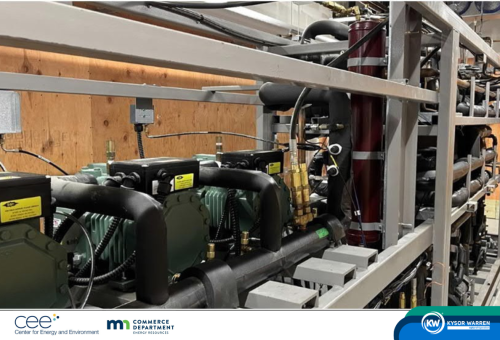
The initially estimated $30,000 cost went up to over $50,000. About $14,000 of this cost was for the rack equipment upgrade, while the remainder was installation cost – especially piping. While all FTE systems need to have the medium temperature and low temperature liquid lines separated, this particular store also needed to have two separate groups of medium temperature suction lines. However, a research team, led by CEE and supported by VEIC, developed engineering estimates of the energy and demand savings of the FTE option and worked with Xcel Energy’s EDA program to help secure a roughly $10,000 utility program rebate. The research team also provided a grant to help cover much of the additional piping cost.
The system started up in the fall of 2022 and CEE closely monitored the rack system energy use and operation through October of 2023 to evaluate the FTE system as part of a research project that gathered information on CO2 refrigeration system options to inform utilities about CO2 system options that are most promising for the Minnesota market. In order to evaluate the savings of the FTE technology, the system was switched back and forth between FTE-active and FTE-deactivated modes a few times during the first year of operation.
In addition to Lunds & Byerlys seeing great cooling performance from the system, CEE’s monitoring and empirical savings analysis verified that operation of the FTE technology and the subsequent increase in medium temperature suction pressure allowed for by the FTE technology provided measurable energy savings that were statistically significant. The graph shows how the system’s operation with and without the FTE technology compared over the range of outdoor temperatures observed. The dots represent individual short-term average values while the lines are regression models that were fit to the observed data. The baseline data and regression model (without the FTE active) is red while the FTE-active data is green. Applying the regression models to typical meteorological year data shows that operation of the FTE technology provided annual energy savings at a level of 7.9% of the rack and gas cooler energy use. Utility system summer peak demand savings was lower at 2.2%. For this store, the percent savings translate to 35,395 kwh per year, or about $3,900 per year based on typical electric rates in Minnesota.
Based on the success of the FTE system in their Highland Bridge store, Lunds & Byerlys has included the FTE technology in additional new stores.
This project was supported by a grant from the Minnesota Department of Commerce, Division of Energy Resources, through the Conservation Applied Research and Development (CARD) program, which is funded by Minnesota ratepayers.