
Comparing Distributed Parallel and Centralized Parallel Refrigeration Systems: Which Fits Your Business?
Businesses looking to cut energy costs and reduce environmental impact must choose refrigeration systems that deliver both efficiency and performance. Sustainable commercial refrigeration is a necessity.
Two popular options for businesses are distributed refrigeration systems and centralized refrigeration systems. Both designs have strengths, but which one suits your business best?
What Are Distributed and Centralized Refrigeration Systems?
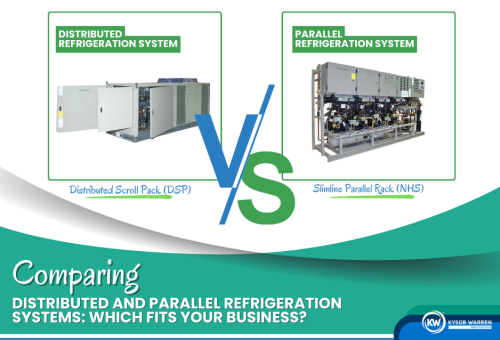
Distributed refrigeration systems are placed closer to the cooling load across multiple smaller compressors. This setup allows for flexibility of installation as it can be placed closer to the area it is serving.
Centralized refrigeration systems also use multiple compressors working together placed in a specified area out of customers’ sight for ease of maintenance. They share the cooling load and can adjust capacity by turning compressors on or off as needed, improving energy efficiency during varying demand.
Why Sustainability Matters in Refrigeration
Kysor Warren focuses on sustainable commercial refrigeration by using natural refrigerants, like CO2, which has a global warming potential of 1. Both distributed and centralized systems can be designed to utilize this refrigerant and others, reducing environmental impact while maintaining high performance.
Properly designed refrigeration systems lower energy bills and help businesses meet environmental regulations, which are likely to be more stringent as time goes on. Choosing the right system can make a big difference in long-term operational costs and sustainability goals.
The Benefits of Distributed Refrigeration Systems
Flexibility
Since components are spread out, it’s easier to customize the system for specific store layouts or product needs.
Reduced Refrigerant Charge
Smaller, localized units mean less piping required overall, which lowers risk and environmental impact.
Simplified Maintenance
Problems in one unit don’t necessarily affect the entire store, making repairs less disruptive to your business.
Ideal for Smaller Stores
Distributed systems are ideal in convenience stores or smaller supermarkets where cooling loads and space are limited.
Advantages of Centralized Refrigeration Systems
Energy Efficiency
Multiple compressors can run at partial loads, saving energy during off-peak hours.
Reliability
If one compressor fails, others can pick up the slack, reducing downtime.
Centralized Control
Easily monitor and optimize system performance from a single point.
Scalability
Suitable for larger supermarkets or mass merchants with high cooling demands.
Making the Right Choice for Your Business
If your business prioritizes flexibility, lower refrigerant charge, and easier maintenance, a distributed refrigeration system might be the better fit. For larger operations focused on energy efficiency, reliability, and single point of control, centralized refrigeration systems offer clear advantages.
Both systems can be tailored with Kysor Warren’s expertise to meet your unique needs, combining sustainability with performance.
We can help your business thrive through sustainable commercial refrigeration.
Ready to explore which refrigeration system fits your business? Contact Kysor Warren to discuss customized solutions that balance sustainability, efficiency, and performance.