
How Retailers Can Align Their Cold Chain with ESG Goals
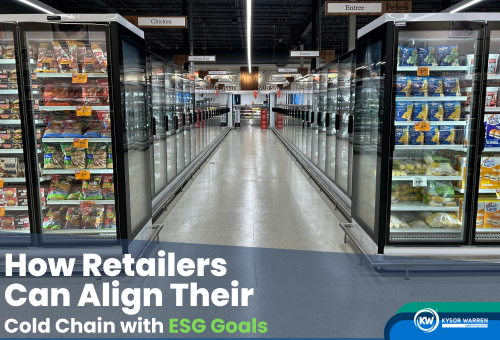
Keeping food cold isn’t just about performance anymore. For retailers, it’s about accountability and how your operations support broader Environmental, Social, and Governance (ESG) goals. The shift toward sustainable commercial refrigeration is changing how supermarkets and food distributors think about energy, efficiency, and long-term impact.
Kysor Warren continues to help retailers make that shift. As part of the Epta Group, our focus on sustainable refrigeration solutions connects directly to what ESG officers are being measured on: lower emissions, cleaner technology, and responsible resource use.
Why ESG Starts with the Cold Chain
The refrigeration systems inside a grocery store can represent up to half of its total energy consumption. That makes them one of the biggest levers for reducing carbon impact. Modern systems using natural refrigerants (like CO₂ and propane/R290) cut greenhouse gas emissions and improve efficiency without compromising cooling performance.
For retailers setting measurable ESG targets, refrigeration offers a practical, visible way to show progress. Switching to sustainable commercial refrigeration systems is an operational upgrade, but it is also a statement about accountability and future readiness.
Building a Responsible Cold Chain
CO₂ Refrigeration Systems
CO₂ systems are gaining ground as one of the cleanest solutions available. They use a natural refrigerant with zero ozone depletion potential and an ultra-low global warming potential (GWP). Beyond compliance, they perform exceptionally well in both medium- and low-temperature applications, making them ideal for supermarket environments.
Distributed Refrigeration Systems
These systems decentralize the load across multiple smaller units. The result is lower refrigerant charge, reduced leak rates, and better maintenance flexibility. For large-format retailers balancing sustainability and uptime, that balance matters.
Parallel Systems
By linking multiple compressors that share the load, parallel systems maintain optimal efficiency across varying conditions. They deliver reliable performance while consuming less energy, which is exactly the kind of measurable improvement ESG teams want to report.
Outdoor Enclosure Systems
Compact and modular, these systems minimize on-site construction and potential refrigerant leaks. They’re ideal for retrofits or urban stores where space and installation logistics are tight. They offer less disruption, faster deployment, and clear sustainability benefits.
Condenser/Gas Cooler Assemblies
High-efficiency condensers and gas coolers help reduce energy waste while keeping system performance steady in demanding climates. When paired with CO₂ or propane refrigerants, they become key components in reducing a store’s overall environmental footprint.
Efficiency as a Measurable ESG Metric
Energy efficiency is a cost issue, but it’s also an ESG metric. By integrating systems like Kysor Warren’s CO₂ and distributed refrigeration platforms, retailers can show quantifiable reductions in energy use and emissions.
Those results feed directly into ESG reporting frameworks such as GRI and CDP, giving sustainability officers the data they need to validate progress.
Partnering for Performance and Accountability
Kysor Warren helps design strategies that align with corporate sustainability commitments. From early-stage consulting to ongoing support, our engineers work with retailers to create solutions that meet both operational and environmental goals.
Our approach is grounded in:
- Sustainability: Prioritizing natural refrigerants and efficient designs.
- Reliability: Building systems that last, reducing waste and maintenance costs.
- Innovation: Constantly refining performance through smart design and technology.
By choosing sustainable commercial refrigeration systems, retailers aren’t just cutting costs or meeting regulations, they’re demonstrating leadership. Each upgrade moves the cold chain closer to carbon neutrality and positions the business as a responsible player in a changing market.
If your ESG goals include lowering emissions, improving energy efficiency, and enhancing long-term value, Kysor Warren can help align your cold chain strategy to make it happen. Contact us today.