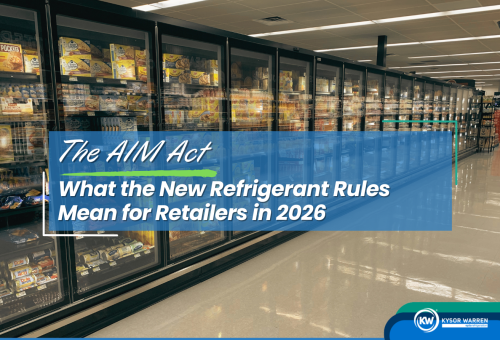
The AIM Act - What the New Refrigerant Rules Mean for Retailers in 2026
In 2026, the AIM Act is no longer something retailers are preparing for. Several deadlines are already behind us, and the next wave is close enough that equipment and system choices made this year will lock in outcomes for the rest of the decade.
If you operate retail refrigeration, this is your moment to look at what should already be in place and line up what needs to happen next.
Sustainable commercial refrigeration has shifted from planning language to day-to-day reality.
What Should Already Be Done as of Early 2026
Some key compliance dates are now in the rearview mirror. Retailers that acted early are in good shape, but those who delayed are feeling more limited options.
As of January 1, 2025, new household refrigerators, vending machines, retail food stand-alone units, and many comfort cooling systems were required to meet strict GWP limits. For retail food environments, this effectively ended the use of many legacy HFC refrigerants in new self-contained equipment.
By January 1, 2026, the bar moved again.
Cold storage warehouses, industrial process refrigeration above -30 °C, and systems with higher refrigerant charges are now subject to GWP limits of 150 or 300, depending on configuration. Retailers with distribution facilities or back-of-house refrigeration tied to store operations needed compliant system designs in place before the calendar turned.
If new equipment was installed in 2025 or early 2026 without accounting for these limits, corrective action may already be required.
The Next Major Dates Retailers Cannot Ignore
Looking forward, the AIM Act timeline accelerates rather than slows.
January 1, 2026, was a major checkpoint for retail food. Supermarket systems, remote condensing units, and many refrigerated food processing and dispensing applications face tighter limits, especially for systems with 200 pounds or more of refrigerant. GWP thresholds drop to 150 in many cases, eliminating a wide range of traditional refrigerants from new installations. This affects everything from warehouses to retail food operations, so it is important to ensure your entire business is compliant.
January 1, 2028, follows closely for specific industrial process and chiller applications operating at lower temperatures.
Retailers planning remodels, store refreshes, or new builds in late 2026 and beyond should already be designing to those future dates. Waiting until permitting or equipment ordering stages leaves little room to adjust, and it is always more economical to plan for the future than be required to make changes as new regulations come into force.
System Choices That Make Sense in 2026
AIM Act compliance does not mean compromising on reliability or efficiency - it changes which system designs make the most sense. Because of this, the market has settled into clearer patterns over the last year. CO2 refrigeration systems are now a mainstream option for larger retail environments. Their ultra-low GWP aligns cleanly with current and upcoming limits, and modern designs support strong efficiency and heat reclaim strategies.
Distributed refrigeration systems continue to gain ground by reducing refrigerant charge and isolating risk. Smaller circuits make compliance easier and improve operational resilience.
Parallel systems paired with approved low-GWP refrigerants remain viable for retailers looking for familiar service models while meeting regulatory limits.
Outdoor enclosure systems and well-matched condenser or gas cooler assemblies play a growing role as refrigerant characteristics change. Better heat management directly affects efficiency, stability, and long-term performance.
These are not experimental layouts as they may once have been. They are proven approaches shaped by the real-world installations.
Sustainability and Performance Are Now the Same Conversation
In 2026, the distinction between regulatory compliance and operational efficiency has largely disappeared. Systems designed to meet AIM Act limits also tend to reduce charge size, improve control accuracy, and support energy optimization.
Retailers that treated the AIM Act as a refrigerant problem often ran into higher costs or limited equipment availability. Those who treated it as a system design challenge generally saw better outcomes.
Sustainable commercial refrigeration now means predictable compliance, stable operating costs, and equipment that will not need early replacement due to regulatory pressure.
Where Retailers Go From Here
This year is about locking in decisions before the 2027 deadlines tighten options even further. Compliance dates are fixed. Construction schedules are not.
Retailers that plan early have access to a wider range of equipment options, more flexibility in system design, and fewer surprises during permitting or inspection. They also avoid last-minute substitutions that can increase cost or complexity.
You need to review upcoming projects against installation dates, not planning dates. Confirm that system designs align with future limits, not just today’s rules, and revisit older specifications that may no longer be valid.
Manufacturers with deep experience navigating these transitions can reduce risk and simplify decision-making. Kysor Warren continues to work with retailers on systems that meet current requirements while staying viable for years to come.
In 2026, the retailers who plan ahead will have more control, fewer constraints, and systems built to last well beyond the next regulatory checkpoint. Contact us today for reliable, energy-conscious systems that meet today’s rules without limiting tomorrow’s options.