
From ECO₂Mini to ECO₂Large: Choosing the Right CO₂ System for Your Store
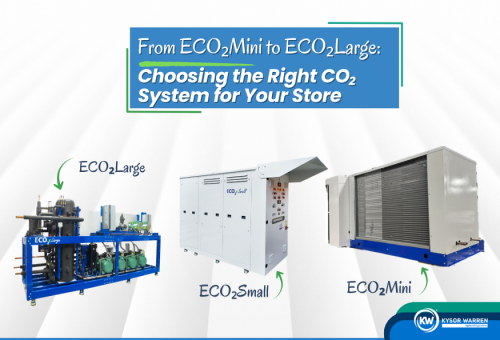
Mini, Small, and Large may sound like a simple size chart. Commercial refrigeration is rarely that neat.
Two stores with similar square footage can have very different cooling demands. One may carry mostly fresh food in medium-temperature cases. Another may have a large frozen department, walk-in coolers, food-preparation areas, or plans for future expansion.
Choosing the right CO₂ refrigeration system means considering more than the store’s physical size. Refrigeration capacity, product mix, installation space, climate, operating conditions, and long-term growth all matter.
Kysor Warren’s ECO₂ platform gives retailers three distinct options: ECO₂Mini, ECO₂Small, and ECO₂Large. Each uses CO₂, also known as R744, a natural refrigerant with zero ozone depletion potential and a global warming potential of 1.
The question is not which system is best overall. It is which system fits the store, the project, and the refrigeration load.
A Quick Look at the ECO₂ Platform
ECO₂Mini is the most compact option in the platform. It is suited to smaller applications, remodels, store expansions, and individual refrigeration loads. Medium-temperature configurations are available at 40,000, 70,000, or 100,000 BTU/h, while low-temperature configurations are available at 40,000 or 70,000 BTU/h. All major components are integrated into one enclosed cabinet, which can be installed indoors or outdoors.
ECO₂Small is developed for small- to medium-sized stores that require more capacity and configuration flexibility. Its cooling capacity ranges from 35 to 106 kW for medium-temperature applications and from 5.5 to 23 kW for low-temperature applications. Available options include remote FTE, integrated ETE, heat recovery, backup units, protective housing, and indoor or outdoor configurations.
ECO₂Large supports larger stores, complex refrigeration loads, and high-capacity applications. Published configurations reach up to 881 MBtu/h for medium-temperature cooling and 377 MBtu/h for low-temperature cooling. The system can be configured for central or distributed refrigeration and installed indoors or outdoors. It also offers multiple compressors, efficiency modules, heat reclaim, and charge protection options.
Published capacities depend on the selected model, operating conditions, and system configuration. Final sizing should always be based on a detailed refrigeration load calculation.
ECO₂Mini: Compact and Ready for Focused Loads
The ECO₂Mini is a single-compressor CO₂ transcritical condensing unit developed for food retail and foodservice applications.
It can be a strong choice for new construction, remodels, refrigerated department expansions, smaller retail formats, and projects with limited equipment space. It supports medium- or low-temperature applications that do not require the capacity of a larger refrigeration rack.
All major components are integrated into one enclosed cabinet, including the compressor, gas cooler, oil separation system, flash tank, electrical panel, and controls. This arrangement supports consistent installation and gives the unit a compact, self-contained format.
ECO₂Mini can be installed indoors or outdoors. Its advanced electronic controls can also integrate with most store monitoring systems, allowing operators to track performance alongside other refrigeration equipment.
Fast-ship standard configurations and a consistent cabinet size can help simplify projects where space and scheduling are important.
ECO₂Mini is a practical fit when the refrigeration load is clearly defined and does not require the broader capacity or compressor flexibility of a larger system.
ECO₂Small: Flexible Capacity for Small and Medium Stores
The ECO₂Small sits between a compact condensing unit and a large multi-compressor system.
It is developed specifically for small- to medium-sized stores and offers adjustable capacity from 35 to 106 kW for medium-temperature applications and from 5.5 to 23 kW for low-temperature applications.
That capacity range gives retailers more room to tailor the system around a complete store layout rather than a single refrigeration load.
ECO₂Small offers options such as remote FTE technology, integrated ETE technology, heat recovery, backup units, protective housing, and indoor or outdoor configurations.
Its standardized platform can simplify system selection while still allowing the project team to choose features based on climate, operating priorities, installation requirements, and sustainability goals.
ECO₂Small can be suitable for neighborhood supermarkets, smaller grocery formats, and medium-sized food retailers that need both refrigerated and frozen capacity from a coordinated system.
It may also work well for businesses expecting moderate growth. A retailer can select a configuration that supports current demand while discussing reasonable future capacity with the project team.
ECO₂Large: Built for Higher Loads and Greater Complexity
The ECO₂Large is the highest-capacity option in the platform. It is a pre-engineered, multi-compressor CO₂ system with installations across global markets.
ECO₂Large supports full-size supermarkets, stores with extensive refrigerated and frozen departments, high-capacity convenience retail, pharmaceutical and medical refrigeration, and process applications.
The system can be installed indoors or outdoors and selected with different low- and medium-temperature compressor arrangements. It can also support central or distributed refrigeration designs.
Its standardized configurations help retailers gain the capacity of a larger system without starting every project with a completely custom rack.
Available features include FTE, ETE, and XTE efficiency modules; CO₂ Charge Protector technology; variable-capacity controls on lead compressors; heat reclaim for water or space heating; air-cooled or adiabatic gas cooler options; remote header configurations; factory-installed CO₂ leak detection; and weatherproof outdoor configurations.
Kysor Warren reports that available modules can improve ECO₂Large energy efficiency by up to 30 percent, depending on system selection and operating conditions.
For retailers planning larger stores or complex refrigeration programs, ECO₂Large offers greater capacity, compressor flexibility, and configuration options.
Consider the Installation Site
Capacity is only part of the decision. The project team should also evaluate where the equipment will be installed and how technicians will access it throughout its operating life.
An indoor machine room may work well for one location, while an outdoor installation may preserve valuable interior space at another. Equipment clearance, piping distances, electrical service, service access, and integration with the store’s monitoring platform should all be reviewed early.
Local climate also matters. Higher ambient temperatures can place additional demands on a CO₂ refrigeration system, making proper gas cooler selection and efficiency technologies particularly valuable.
ECO₂Mini places all major components in one cabinet, making it useful where a compact arrangement is preferred. ECO₂Small offers a standardized format with optional housing and indoor or outdoor configurations. ECO₂Large supports more complex central and distributed designs for sites with broader refrigeration demands.
The best installation is not simply the one that fits on opening day. It should remain accessible for inspection, maintenance, repair, and future equipment changes.
Plan for Growth Without Oversizing
Future growth deserves attention, but buying far more capacity than the store needs can create problems of its own.
Retailers should consider planned store expansions, possible additions to frozen or fresh-food departments, future walk-in coolers or freezers, seasonal refrigeration demand, new foodservice areas, changes in product mix, expected operating hours, and backup requirements.
ECO₂Mini can support a targeted addition or clearly defined load. ECO₂Small offers a wider operating range for growing small and medium stores. ECO₂Large provides the capacity and configuration flexibility needed for larger facilities and more complicated refrigeration programs.
Growth planning works best when it is tied to an actual store plan rather than a general estimate. A load calculation can show how much capacity the store needs now and how future changes may affect system selection.
Think Beyond Refrigeration Capacity
Capacity answers how much cooling the system can provide. It does not answer every question about long-term performance.
Retailers should also review:
- Energy efficiency goals
- Natural refrigerant strategies
- Heat recovery requirements
- Equipment redundancy
- Monitoring and control integration
- Local service capabilities
- Maintenance access
- Refrigerant charge protection
- Current and future regulations
These factors can change which ECO₂ system is the strongest fit, especially when two models appear capable of meeting the basic refrigeration load.
A store that prioritizes compact installation may lean toward ECO₂Mini. A growing small or medium retailer may need the flexibility of ECO₂Small. A high-demand supermarket may benefit from the compressor configurations and efficiency options available with ECO₂Large.
Match the System to the Store
Choosing among ECO₂Mini, ECO₂Small, and ECO₂Large begins with the store’s refrigeration load, but the decision should also reflect installation conditions, performance goals, and future plans.
All three ECO₂ systems support natural commercial refrigeration with CO₂. The difference is how each platform delivers the required capacity, installation flexibility, and system options.
ECO₂Mini keeps the system compact for focused loads. ECO₂Small gives small and medium stores greater capacity and choice. ECO₂Large supports demanding applications with multiple compressors and a broader range of configuration options.
To determine which ECO₂ system fits your store, contact the Kysor Warren sales team. The team can help review refrigeration loads, site conditions, installation requirements, efficiency goals, and future plans.