
How Heat Recovery Can Support Store Efficiency During Colder Months
A refrigeration system spends every hour of the day moving heat.
It pulls heat away from refrigerated cases, freezers, walk-in coolers, and stored products. That heat then has to go somewhere. In a conventional setup, much of it is rejected outside through the condenser or gas cooler.
At the same time, the store may be paying to heat water, warm occupied spaces, or support other building needs.
That is where heat recovery becomes interesting. Instead of treating all rejected heat as waste, a properly planned system can capture part of it and put it to work elsewhere in the store.
During colder months, this approach can help retailers connect refrigeration performance with broader winter energy planning.
Refrigeration Does Not Create Cold
It sounds strange, but refrigeration does not create cold. It removes heat from one location and transfers it to another.
The refrigerant absorbs heat from refrigerated spaces, then carries it through the system. Compressors raise the refrigerant’s pressure and temperature, and the system eventually rejects that heat through a condenser or gas cooler.
Heat recovery adds another step to that process. A heat exchanger captures usable thermal energy before it is released into the environment. That recovered energy can then be transferred to a water or building heating circuit, depending on the system design.
The refrigeration system still performs its primary job of maintaining product temperatures. Heat recovery simply gives the rejected heat a second purpose.
Where Can Recovered Heat Be Used?
The best use depends on the store’s heating requirements, plumbing system, climate, operating schedule, and refrigeration load.
Potential applications may include:
- Domestic or service hot water
- Space heating
- Air-handling system support
- Floor heating
- Preheating water before it enters a conventional heater
- Other suitable building heating loads
A supermarket can have considerable year-round refrigeration demand. That means heat may be available while the store is operating, including during periods when outdoor temperatures are low, and building heating demand is higher.
Still, available heat and store demand will not match perfectly at every hour. The system needs appropriate controls, storage, piping, heat exchangers, and backup heating capacity to manage those differences.
Heat recovery should be engineered around the store, not added as a generic accessory without a clear use for the recovered energy.
Why Colder Months Make Heat Recovery Valuable
During warm weather, rejected refrigeration heat may have limited use unless the store has a steady demand for hot water.
Winter changes the equation.
Colder outdoor temperatures increase the need for space heating, while stores continue to operate refrigerated cases and freezers. This creates an opportunity to direct recovered heat toward a load that would otherwise require energy from a boiler, electric heater, or another source.
The possible benefit is easy to understand. If refrigeration heat can satisfy part of the building’s heating demand, the primary heating equipment may not need to produce as much heat.
Actual savings will depend on several factors:
- The refrigeration system’s operating profile
- The amount and temperature of recoverable heat
- Local winter conditions
- The building’s heating requirements
- Store operating hours
- Heat exchanger and control performance
- The cost of electricity, gas, or other heating energy
- How closely refrigeration operation matches heating demand
A detailed energy review can help determine whether the available heat and the store’s requirements align well enough to justify the investment.
CO₂ Refrigeration and Heat Recovery
CO₂, also known as R744, is a natural refrigerant used in commercial food retail systems.
Transcritical CO₂ systems can reject heat at temperatures that may be useful for heat recovery applications. System design and operating conditions determine how much heat is available and how effectively it can be used.
This creates a strong connection between natural commercial refrigeration and whole-store energy planning. The refrigeration system is no longer considered only as cooling equipment. It can become part of a coordinated strategy that addresses refrigeration, heating, hot water, controls, and overall energy use.
That broader view is important because sustainable commercial refrigeration is not based solely on the choice of refrigerant. The refrigerant matters, but system sizing, controls, heat recovery, maintenance, and daily operation also influence environmental and financial performance.
Heat Recovery Is Available with ECO₂Small
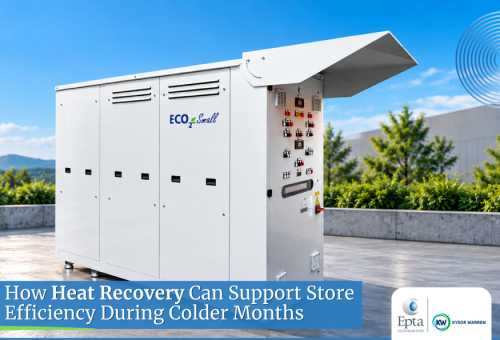
Kysor Warren’s ECO₂Small is a standardized CO₂ refrigeration system developed for small and medium-sized stores.
Its adjustable cooling capacity ranges from 35 kW to 106 kW for medium-temperature applications and from 5.5 kW to 23 kW for low-temperature applications.
Available configuration options include heat recovery, backup units, housing, remote FTE, and integrated ETE technologies. This allows project teams to select features based on the store’s climate, refrigeration loads, installation requirements, and performance priorities.
Including heat recovery as an option gives smaller and medium-sized retailers the opportunity to consider whole-store energy use when planning their CO₂ refrigeration systems.
The value is not simply that heat recovery is available. It can be evaluated as part of the original system configuration rather than treated as a disconnected building upgrade later.
Controls Determine How Well the System Responds
Heat recovery has to respond to changing conditions.
Refrigeration loads move throughout the day as products are stocked, doors are opened, defrost cycles run, and store traffic changes. Heating demand also rises and falls as outdoor temperatures and occupancy levels shift.
Controls help coordinate these two sides of the building.
A well-planned control strategy may prioritize heat recovery when there is a useful heating demand, then allow the system to reject heat normally when that demand is satisfied. It should also protect refrigeration performance under every operating condition.
Monitoring can help store and service teams review:
- Heat recovery operating hours
- Supply and return temperatures
- Heating demand
- Refrigeration pressures and temperatures
- Backup heating operation
- Energy consumption
- Alarm activity
- Seasonal performance trends
This information gives retailers a clearer picture of whether the system is delivering the expected benefit.
Heat Recovery Still Requires Careful Planning
Recovered heat is useful, but it should not be described as completely free energy.
The refrigeration system is already operating, creating a recovery opportunity. However, pumps, controls, heat exchangers, piping, storage tanks, installation work, and maintenance may add cost and energy use.
Project teams should answer several questions before selecting a heat recovery configuration:
- Where will the heat be used?
- Is that heating demand available at the same time as the refrigeration load?
- What water or air temperature is required?
- Will thermal storage be needed?
- How will backup heating operate?
- Can the system be maintained without disrupting store operations?
- How will performance be measured?
- What is the expected payback based on local energy costs?
These questions help turn a promising idea into a practical operating strategy.
A Wider View of Store Efficiency
Energy-efficient refrigeration systems should not be planned in isolation from the rest of the building.
Refrigeration may be one of a food retailer’s largest continuous energy demands. Recovering usable heat gives retailers another way to improve how that energy moves through the store.
During colder months, the opportunity becomes particularly relevant. Refrigeration equipment continues removing heat while the building requires warmth. Connecting those two needs can reduce avoidable waste and support lower operating costs.
CO₂ refrigeration, heat recovery, FTE, ETE, accurate controls, and proper maintenance can all contribute to a more coordinated approach. The right combination depends on the store, its climate, and its actual operating demands.
Contact the Kysor Warren sales team to discuss ECO₂Small, heat recovery options, and a refrigeration configuration suited to your store.