
News /

Food Waste vs Energy Use - The Sustainability Trade-Off Retailers Get Wrong
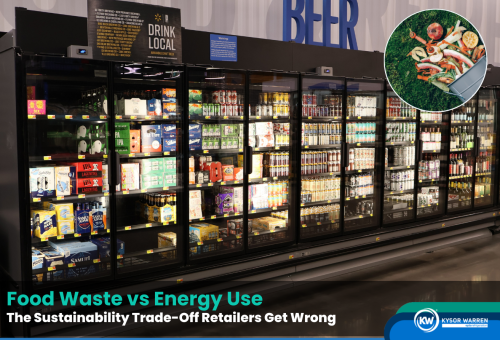
Food Waste vs Energy Use - The Sustainability Trade-Off Retailers Get Wrong
When the conversation turns to sustainable commercial refrigeration, energy use usually takes center stage—kWh reductions, smarter controls, and more efficient components. But focusing on energy alone overlooks a much larger environmental (and financial) cost: food waste. In many retail environments, food waste carries a bigger environmental cost than energy consumption ever will.   The Sustainability Blind Spot Energy is easy to measure. You can track it, chart it, compare it year over year. Food waste? It hides in markdowns, shrink reports, early pulls, and customer complaints. Every package of meat, fish, or dairy that gets thrown away represents wasted water, feed, transport, processing, refrigeration, and labor. When product spoils early due to poor temperature control, the environmental cost is already baked in long before it reaches the trash bin. A refrigeration system that saves energy but allows temperature swings isn’t sustainable. It’s just efficient at the wrong thing.   Why Temperature Stability Is the Real Sustainability Multiplier For fresh and protein-heavy categories, temperature consistency matters more than almost anything else. Even small fluctuations can shorten shelf life, and inconsistent airflow can create warm spots. Overworked systems can lead to uneven recovery times after restocking or peak traffic. All of this increases the likelihood of spoilage, especially in open or high-turn displays. From a sustainability standpoint, stable refrigeration delivers three major sustainability wins at once:
  • Reduces food waste
  • High product quality and safety
  • Lowers total environmental impact per item sold
When product lasts longer and sells through as intended, fewer replacements are needed. That’s fewer deliveries, less packaging, less energy, and less waste overall.   Energy Efficiency Without Product Protection Is a False Economy There’s a temptation to chase energy savings alone. It’s easy to be impressed by lower compressor runtime, reduced power draw, and minimal equipment footprint. But if those gains come at the expense of temperature stability, retailers end up paying elsewhere. More shrink. More labor managing markdowns. More customer complaints. More product pulled early “just to be safe” - you have to do it, because safety is paramount. But true sustainability looks at total system impact, not just the energy meter. That’s why modern sustainable commercial refrigeration focuses on balance: efficient systems that also deliver consistent, reliable cooling where it matters most.   Smarter Refrigeration Reduces Waste at the Source Today’s advanced refrigeration solutions make it possible to improve both energy performance and product protection. Technologies that help keep temperatures tight include:
  • Improved airflow and case design
  • Shelf‑level temperature control
  • Advanced electronic controllers
  • Night curtains for load reduction
  • Natural refrigerants like CO₂ and R290
Self-contained and distributed systems also play a role here. By localizing cooling and reducing long refrigerant runs, these systems can improve responsiveness and reduce the risk of uneven temperatures across long lineups. Less stress on the system means better performance where product lives.   Why Protein Categories Raise the Stakes Meat and fish departments are where this trade-off becomes impossible to ignore. These products are:
  • High‑value
  • Temperature sensitive
  • Quick to spoil
  • Critical to shopper perception
A small improvement in temperature stability can mean:
  • Longer sell-by windows
  • Fewer emergency markdowns
  • Less product pulled for safety concerns
  • More consistent customer experience
From a sustainability lens, protecting these categories delivers outsized returns. Less waste here has a far greater impact than marginal energy savings elsewhere in the store.   Sustainability That Actually Holds Up Sustainable commercial refrigeration isn’t a box-ticking exercise where you choose between energy efficiency and food protection. You need a system that does both well. Retailers who focus only on energy metrics risk missing the bigger opportunity. Those who invest in refrigeration that stabilizes temperature, reduces waste, and runs efficiently over time end up with:
  • Lower environmental impact
  • Lower operating costs
  • Better product integrity
  • Stronger long-term performance
That’s sustainability that works in the real world, not just on paper.   Rethinking What “Efficient” Really Means Efficiency seems to suggest that “less is better” but it’s actually about using energy well. When refrigeration systems help products last longer, sell through properly, and stay within tight temperature ranges, they reduce waste at every stage of the supply chain. That’s a sustainability win that compounds daily. The retailers getting this right aren’t chasing one metric. They’re building refrigeration strategies that respect both the product and the planet. And that’s where sustainable commercial refrigeration starts to make real sense. If you’re ready to become truly efficient, contact Kysor Warren today.