
News /
How FTE Supports Energy-Efficient CO2 Refrigeration in Warm Weather
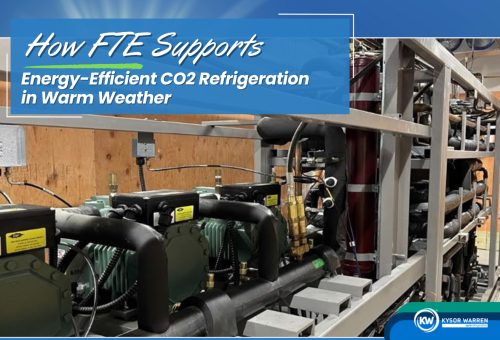
We know that CO2 refrigeration has a lot going for it. It uses R-744 (a natural refrigerant), supports sustainability goals, and helps retailers move away from higher-impact refrigerants while still getting the performance they need from modern commercial refrigeration systems.
Then summer arrives.
Warm weather can make CO2 transcritical systems work harder, especially in high ambient conditions. The system still has a job to do - frozen food has to stay frozen, medium-temperature products have to stay safe and appealing. Produce, dairy, meat, beverages, and prepared foods all need consistent cooling while the store gets hotter, busier, and more humid.
That is where FTE becomes a serious part of the efficiency conversation.
FTE is built for CO2 transcritical performance
What is FTE? FTE stands for Full Transcritical Efficiency. We describe FTE as technology that can be added to any CO2 transcritical system to improve efficiency and reliability in all climates.
The overall idea is straightforward. FTE improves system performance by overfeeding the evaporators without risking compressor flood-back, creating a more efficient and reliable system across all climates and potentially eliminating the need for adiabatic gas coolers in warmer climates.
Eliminating the need for those gas coolers matters because, in warm weather, many refrigeration systems consume more energy to maintain the same performance. The product on the shelf does not care how hot it is outside; it still needs the right temperature.
Why warm weather changes the math
In a CO2 transcritical system, high ambient conditions can increase energy consumption. Standard CO2 transcritical systems are known for their low environmental impact, but they also exhibit increased energy consumption during high-ambient operation.
FTE addresses efficiency from a different angle than basic maintenance. Maintenance prevents equipment from losing performance due to dirt, blocked airflow, improper stocking, or poor operating conditions. FTE supports the refrigeration cycle itself.
FTE operates on the intermediate-pressure side of the CO2 refrigeration cycle, on the suction side of medium-temperature evaporators. It reduces superheat in the medium-temperature evaporators, allowing them to accommodate more refrigerant and raise the suction temperature and pressure. That can increase medium-temperature compressor suction pressure, reduce compression ratio, and lower energy consumption.
In plain English, the system does not have to work as hard to do the job, which is truly important in summer.
Sustainable commercial refrigeration needs efficiency and reliability
Sustainability is often about choosing natural refrigerants, but it is also reliant on how efficiently the system runs day after day.
FTE uses eco-friendly R-744 (CO2), an environmentally sound refrigerant that supports sustainability goals. That gives retailers a clear path to discuss sustainable commercial refrigeration without overlooking the operational side of the business.
A store still has to manage energy costs while protecting product. You want minimal service headaches, but your refrigeration system still has to perform on the hottest days of the year (as well as still working during mild weather).
FTE helps connect those dots.
Better efficiency supports better food protection
Energy efficiency matters most when the system is under pressure. In warmer months, refrigerated cases and storage areas must handle higher heat, higher humidity, and more frequent door openings while still protecting product quality.
That is where a strong refrigeration strategy makes a difference. FTE supports CO2 system efficiency, while features like humidity-controlled drawers, improved airflow, and steady temperature management can help retailers protect fresh food at the case and storage levels.
The result is a smarter approach to summer performance. The system side works more efficiently, and the food side gets the consistency it needs to stay fresh, appealing, and ready for shoppers.
Efficiency gains still need good maintenance
Technology can do a lot, but it cannot overcome neglect forever. During summer, routine maintenance still does the heavy lifting. Our cleaning and maintenance manual recommends monthly attention for condensers on self-contained cases, along with cleaning frequencies for categories like produce, dairy, meat, drinks, and frozen food.
The same guidance warns teams not to block airflow or stock beyond the load line, since discharge and return flues must remain open for proper refrigeration and air movement.
That pairs well with FTE. The system side supports efficiency. The store side protects operating conditions. Together, they help reduce avoidable strain.
A strong summer plan should include:
- Checking airflow around cases and equipment
- Keeping coils clean
- Confirming fans are working
- Watching for case icing or product frosting
- Keeping grilles clear of signs, debris, and overstocked product
- Reviewing case temperatures during peak heat
- Working with qualified refrigeration technicians for deeper service needs