
How FTE Helps CO2 Refrigeration Systems Save Energy Beyond Summer
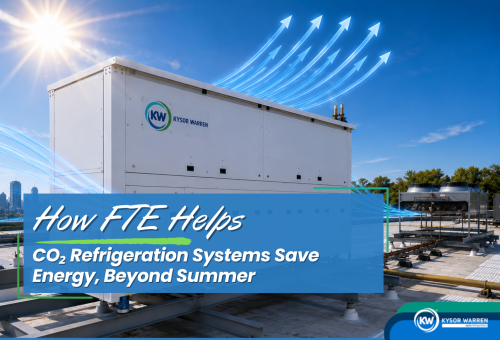
Summer gets most of the attention in commercial refrigeration, and that is fair, as hot weather can cause the most problems for a refrigeration system. Heat makes systems work harder, stores feel busier, doors open more often, and every weakness shows up faster.
But the smartest refrigeration improvements don’t clock out when the weather cools down, and that is why FTE is particularly interesting.
FTE, or Full Transcritical Efficiency, is Kysor Warren Epta US technology built for CO2 transcritical systems. It supports energy savings and system reliability across the year, not only during the hottest months. For grocery retailers and food merchants looking for natural commercial refrigeration and stronger long-term performance, it means that energy efficiency is not a seasonal bonus - it’s an operating strategy.
Why CO2 Refrigeration Needs Year-Round Thinking
CO2 refrigeration has a strong sustainability story because CO2, also known as R-744, is a natural refrigerant. That makes it a practical fit for retailers trying to lower environmental impact while maintaining dependable cold-chain performance.
The challenge is that commercial refrigeration systems do not operate under one neat set of conditions. A grocery store rack must respond to outdoor temperature fluctuations, indoor load changes, case traffic, product rotation, door openings, defrost demands, and the store's daily rhythm.
In warm weather, the pressure is obvious. In cooler weather, it’s not quite so visible.
FTE is valuable because it does not just chase hot-weather savings. In an independently conducted case study, the Lunds & Byerlys Highland Bridge store in St. Paul, Minnesota, selected FTE partly because it offered greater simplicity than options such as ejectors and parallel compression. It could also provide year-round energy savings, while many system-level efficiency options for booster CO2 systems focus mainly on hot-weather performance.
For stores of any size, that is a big factor. A technology that helps in August is useful, but a technology that helps in August, October, January, and April is easier to build into a long-term efficiency plan.
How FTE Improves Efficiency
FTE works by flooding evaporators in coolers. That allows the medium-temperature suction pressure to increase throughout the year, reducing compressor power consumption. The higher suction pressure is possible because flooded liquid throughout the evaporator cooling coils can absorb the same amount of heat at a lower temperature difference between the refrigerant and the case air than in a typical coil condition, which is roughly half liquid and half vapor on the inside surface.
In simple terms, the tubes in the refrigeration system that carry heat away are only partially filled with cold liquid, which is an inefficient use of available space. FTE fills more of those tubes with cold liquid, so the system can absorb heat more easily, which means the compressor does not have to work as hard.
Even if that still sounds technical, the business point is easy to understand. Compressors are not cheap to run, so when the system can do the cooling work with less compressor strain while still keeping product at safe and consistent temperatures, it’s time to pay attention.
Real Store Data Beats Theory
The strongest part of the FTE story is that it has been measured in a real grocery environment. At the Lunds & Byerlys Highland Bridge store, the system started up in fall 2022. The Center for Energy and Environment monitored rack system energy use and operation through October 2023. To evaluate FTE savings, the system was switched between FTE-active and FTE-deactivated modes several times during the first year of operation.
If this kind of testing were done in a lab, you could question the results. Lab conditions are not always the same as real-world conditions, but testing a real grocery store gives you important data - weather changes, customer traffic changes, loads change, teams stock shelves, doors open...there are so many different ways that a physical store can throw off a refrigeration system that it would be nearly impossible to replicate in a lab environment.
The monitoring found that FTE operation and the increase in medium-temperature suction pressure it enabled provided measurable, statistically significant energy savings. The analysis showed annual energy savings of 7.9% of rack and gas cooler energy use. For that store, that equaled 35,395 kWh per year, or about $3,900 at typical Minnesota electricity rates.
The result was strong enough that Lunds & Byerlys included FTE in additional new stores after the Highland Bridge project.
The Cost Conversation Matters Too
As you can see, efficiency decisions always have a cost side. The case study notes that the initially estimated additional cost of $30,000 rose to more than $50,000, with about $14,000 attributable to the rack equipment upgrade and the remainder primarily to installation, especially piping. It also notes that all FTE systems require separate medium- and low-temperature liquid lines, while the specific store also required two separate medium-temperature suction line groups.
It must be noted that FTE is not a magic solution but a real system design choice. It needs planning, piping considerations, and the right project fit.
For retailers, that points to a practical next step. Efficiency upgrades should be evaluated not only on equipment cost, but also on utility incentives, long-term energy savings, operating goals, and sustainability targets.
Why This Matters for Sustainable Refrigeration Planning
Food retailers are under pressure from multiple directions: energy costs, product safety, refrigerant choices, store uptime, sustainability reporting, customer expectations, and much more.
FTE fits into that conversation because it supports CO2 refrigeration efficiency while preserving the broader sustainability story. It helps operators pursue natural commercial refrigeration without treating energy performance as an afterthought.
A refrigeration system should not force retailers to choose between better environmental responsibility and better operating performance. The best path is equipment and technology that support both.
FTE gives retailers another way to build that kind of store.
A Stronger CO2 Strategy Starts With the System
The refrigeration rack is not the only part of store efficiency, but it is a major one. If the rack is working harder than needed every hour of every day, the cost shows up somewhere.
FTE helps address this by improving the way CO2 transcritical systems handle medium-temperature loads. It can support savings beyond the obvious summer peak and give operators a more efficient foundation for year-round refrigeration performance.
For stores planning new builds, major remodels, or CO2 refrigeration system upgrades, FTE should be part of the conversation early. Kysor Warren helps retailers evaluate CO2 refrigeration technology with both performance and sustainability in mind, including FTE for projects where year-round efficiency is a priority.
To learn more about FTE, CO2 refrigeration systems, sustainable commercial refrigeration, and natural commercial refrigeration solutions, connect with Kysor Warren and start planning a smarter path for long-term system performance.